
This is another in our series of previews of the material inside our knowledge base. We have mindset material to help owners, managers and mentors understand key concepts and communicate them effectively to their Teams; Team-facing training material that directly shares important knowledge and expectations; and hands-on tools like conversation scripts, meeting agendas, decision trees, worksheets, and other methods to help you organize information and triage your ongoing process toward change and growth.
“The person who says they know what they think but cannot express it usually does not know what they think.” —Mortimer J. Adler, “How to Read a Book”
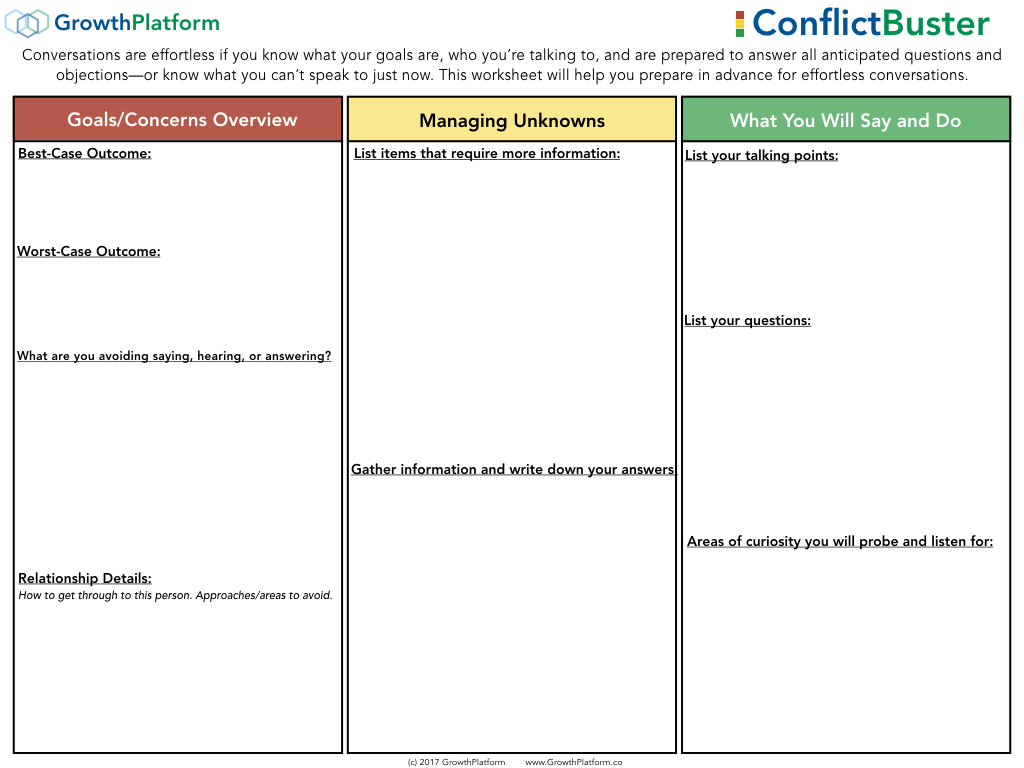
The Conflict Buster helps you process a situation into an outline for a conversation and a group of lists to help you execute that conversation as effectively as possible.
I'll say before you read this that often just beginning this exercise is enough to get you to pick up the phone, write an email, or walk across the hall.
So if you're reading this with a pressing need, it's well worth taking a crack at the Conflict Buster now. The result matters more than the process.
But reading this article can help you come to terms with why conflict is a part of business, why navigating conflict is a large part of the value leaders bring, what the risks of unaddressed conflict are, and what to do about it.
The Crowbar of Peace
The ConflictBuster is like a crowbar: simple, unadorned and perfectly suited for its purpose.
Its purpose is leveraging your natural instincts so that you never avoid a conflict again.
Why focus on busting conflict avoidance?
Because avoiding conflict in conversations we don’t want to or know how to have is a problem everyone has had at some point. And going into conflict with guns blazing to protect yourself emotionally is how one gets the reputation for being capricious and inconsistent, damaging our credibility, and thus our capacity to lead.
And make no mistake, a big part of why leaders get paid more is because it’s their job to navigate and handle conflict and make things come out right.
What Conflict?
Now that I’ve dropped those stakes on you, if you’re like some people, you’re probably thinking, What, me? Conflict? What conflict could I possibly be avoiding?
As I touched on above, if you reverse-engineer the demands of leadership, you get a pretty good list of the types of conversations that people like to avoid:
- When we must develop understanding, buy-in, or agreement with others
- When we must align motivations with vision
- When we must set or reinforce expectations
- When we must confront someone or disagree
- When we must assign new or onerous duties
There’s a lot of pressure in all those “musts,” and these conversations can become complicated by emotions if we aren’t able to lay out a reasonable plan of action.
Anytime we feel, even on a subtle level, that we stand the risk of being tongue-tied, inarticulate, or caught without a good answer—or if we’re afraid to get a bad answer—if we aren’t confident that we can say what needs to be said, answer what needs to be answered without resorting to silence or emotional maneuvers to regain control of the conversation—many of us will avoid such situations almost instinctively.
And that instinct is a good one. But it’s an instinct that says “pause to prepare,” not “avoid this conversation forever.” The ConflictBuster gives you a solid method to seize on this instinct and maximize it.
The overwhelming majority of conflict in our lives can be easily handled once all the necessary information is gathered. The ConflictBuster helps us gather the information so we can resolve conflict and get on with what we’re trying to do—care for patients, run a business, and enjoy ourselves and each other’s company as much as possible in the process.
Conflict Avoidance Up and Down the Line
The time and effort spent avoiding tough conversations can become ridiculous, and the rot that results from unaddressed conflict can be disastrous. People stop cooperating or stop talking altogether, they act without explanation or outside standard norms and processes, they leave jobs, and more. The risk of having no plan for dealing with conflict is recklessly high.
While it’s a peacemaking instinct to proceed cautiously into conflict to avoid triggering inappropriate, unconstructive responses, peace is more than the absence of visible conflict. The issue at hand must be dealt with. When there is too much silence, too much surface-level peace, leading conversations to uncover and analyze these situations is a key survival skill for a business.
If owners and managers can’t confront Team members until it’s too late, that causes turmoil and turnover that doesn’t need to happen. When the Team believes it’s not worth the reaction (or lack of it) to share information with owners and managers, insidious problems can creep in and can have dire consequences.
This is especially common where there is hierarchy involved, such as a problem with a dentist, manager, or more senior/powerful Team member. It also comes into play when to bring up an issue would bring blame or repercussions on oneself or a peer.
As a side note, a widely-shared “No Penalty” policy is an absolutely priceless component of your communications process, and it must be scrupulously adhered to.
Mastering Conflict
If you’ve never taken a look at conflict resolution as a skill to be improved, you’re in for a treat, because it’s not an exaggeration to say that becoming methodical and purposeful in your approach to navigating conflict will dramatically change your life. You can read all about the topic in a thousand books, and it’s well worth your time to find some books and articles that speak to you.
But the ConflictBuster, like all of our tools, was meant for people who want to skip to the back of the book and get the benefit without too much delay; we do the learning and lay out the process, you fill in the blanks.
Now, you will get more out of using the Conflict Buster as you continue to use it. Successful conflict interactions will prove the worth of scripting and strategizing your conversations ahead of time, and working the ConflictBuster process will help you improve your understanding of how you and others tick when it comes to conflict. But you can start getting benefit from it the first time you use it.
As we’ve talked about before, it’s a cognitive “hack” to translate our thoughts into forms outside our heads. Many people have noticed that making mind maps, lists, and writing letters we don’t mean to send can help us break a mental logjam and expose new possibilities.
The reasons behind this are why we provide worksheets, decision trees, and other such tools. People are able to work more rationally with their thoughts when they can see, hear, and evaluate them with their senses. Sometimes just the basic logical demands of language will help tip us off to something amiss in our thoughts: when we try to write things out, they don’t make sense, or they contradict themselves. For these reasons, we have found the value of these types of exercises and share them in the Growth Platform as tools.
ProTip: Brainstorming
A crash-course tip for brainstorming here. Creativity 101: write first, then judge. Don’t even try to rank or prioritize until you feel you’ve exhausted your list. Start on a separate piece of paper and just start writing. Try to list 3–5 items that you hope will come from the conversation and 3–5 results you hope will not happen. You may find yourself coming up with things you imagine that you or the other party will say. Write these down. Get it all on paper. This is all valuable. The magic is in being honest, putting your thoughts into words, and seeing them in print for the first time.
Many times, just beginning this exercise is enough to get you to pick up the phone, write an email, or walk across the hall, but we’re happy to share the details on each area and each step of the exercise in order to ensure your success in using it.
Red Zone: Goals and Concerns Overview
Steps 1 and 2:
Worst-case and Best-case
Best and worst case are here to help you put a scope on the issue. By listing what you hope will happen and what you hope won’t happen, you put limits around your mental process and begin to focus your intentions on having a real live conversation. The best-case and worst-case assessments also allow you to wrangle your thoughts and feelings back into life-sized proportions, which helps a great deal in conquering avoidance of hearing and saying what needs to be heard and said.
Step 3:
What are you avoiding saying, hearing or answering?
This item asks you to rip the bandaid off and name the thing you’re intimidated or stumped by if you can. You are choosing to take the issue head on. In step three, you’re painting the bullseye. This step is often as far as you need to go.
But if you don’t feel like you have a solid answer here, dig deeper on steps 1 and 2.
Step 4:
Relationship details: How to get through to this person. Approaches/areas to avoid
If you’re new to planning and pre-scripting your conversations, this item may raise an eyebrow, but it’s a key step in being considerate and effective to have learned from past interactions.
Sometimes we’re avoiding a person or a history, not the conversation itself. Maybe our styles don’t mesh well, or communication has been consistently tricky in the past between you and this person.
This section asks us to explore our thoughts and feelings about the particular person or people we are going to deal with. Consider the conversation you are preparing for in terms of approaches that will help and hurt, and map them out accordingly.
- Is this person sensitive to criticism in a particular area?
- Do they handle criticism better when it’s handled a particular way?
- Do you need to remind yourself to avoid things in your own habits that you know will have a bad effect?
- Do you need to remind yourself of areas of sensitivity this person provokes in you?
This is where to remind yourself and come up with specific ways to do that. List them and make a commitment to not take it personally for the sake of your success.
Do you and this person have preexisting tension? It may be necessary to clear the air about that in order to talk about the present matter, or it might be as simple as acknowledging it and agreeing to leave it alone for now.
Yellow Zone
Step 5:
List items that require more information
This is where you take the goals that you have uncovered and detailed in the Red Zone and map out the areas you know you’re light on information on.
The purpose of this section is to prompt you to list your unknowns and to try to gather as much information as you can. The translation step, the mental processes to express yourself in language, are powerful forces to tap.
Whatever remains unknown after steps 5 and 6 can be used to prompt a reassessment of the issue or can be brought to your conversation as areas of curiosity or direct questions.
Step 6:
Gather information and write down your answers
As we’ve discussed, summarizing is a key step for organizing thoughts into effective language. This item allows you to take your first pass at summarizing your findings.
After completing step 6, take a look at the Red Zone and see if your goals have changed. Make any changes.
Green Zone
Step 7:
List your talking points
These are the things you want to ask and say, worded clearly, carefully and considerately.
Step 8:
List your questions
You ask questions for two reasons:
- To gain information, and after that,
- To establish agreement on facts
Work out the questions that need to be asked and make sure that you ask them. Scripting and practicing how you will ask questions is worth the effort. Use a guideline. There are any number of sites and books with lists for communicating clearly. To help get the juices flowing, just work with the first one you see.
Step 9:
Areas of curiosity you will probe and listen for
If you have these, list them. Otherwise, use this section to improve your communications technique.
If you can spot unproven assumptions on your part, you can list them here. This way you can remember areas you wish to remain open minded about, avoiding asking questions or making statements that close down corridors in the conversation for no reason.
Also, use it to remind yourself of the things you will listen for. First, this includes things like gauging and following up on interest, understanding and other reactions around specific areas of interest. This will help you confirm that you are communicating as clearly as you’d like.
And last, all of us, especially in tense or crucial conversations, need to remember to listen more and listen better. The Step 9 list can help you with that, too. Use it to remind yourself to break bad conversational habits that ruin your ability to connect with people and gather information.