
This post is to give you a peek inside our e-learning suite. We want to give you a sense of our style, our values, and the kinds of information we share. Enjoy as some shop-talk reading, and share with a colleague or your Team members. We’d love to hear how any of this conforms to your experiences, sums them up nicely, fulfills a need for training—or seems to come from somewhere totally unexpected. Let us know in the comments or by dropping us a line at team@growthplatform.co —Cheers! RK
Background Note: If you’re not providing thoughtfully complete standards and expectations material with the team, you’re not supporting them. Studies and successful practice show that sharing clear rationale behind Team expectations, or “The Why” is the most important thing you can give a competent team. Training is not about doing the learning for your Team, and it’s not about assigning “The How” and letting them bump into walls as they try to understand how to adapt their style to new and highly specific methods. It’s about giving them solid explanations, rationale, heuristics, and other ways for them to connect their experience, training, and personal frame of reference to what they are tasked with doing, and providing material they can reference on an ongoing basis. If you like the ideas in this post and want to share them with your Team, be sure to share the material with them, at least the graphics, which are designed for that purpose.
There’s one thing you need to understand to take great care of patients, and that one thing is four things.
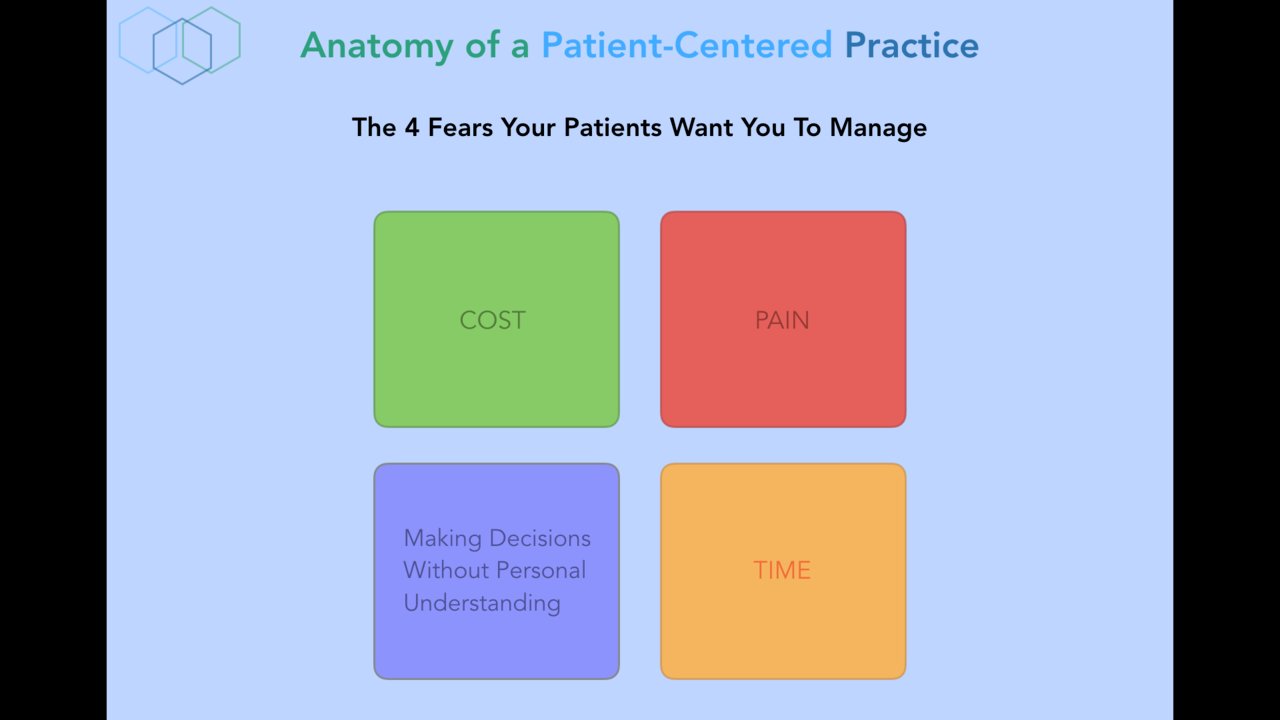
We call them the 4Fears. In this article we’re going to say everything about them you need to know to anticipate them and handle them so your patients don’t have to. Providing this value is the most important thing you can do to earn trust and loyalty, and all the rewards that propagate from them indirectly.
The 4Fears are:
Cost
Pain
Making Decisions Without Personal Understanding, and
Time
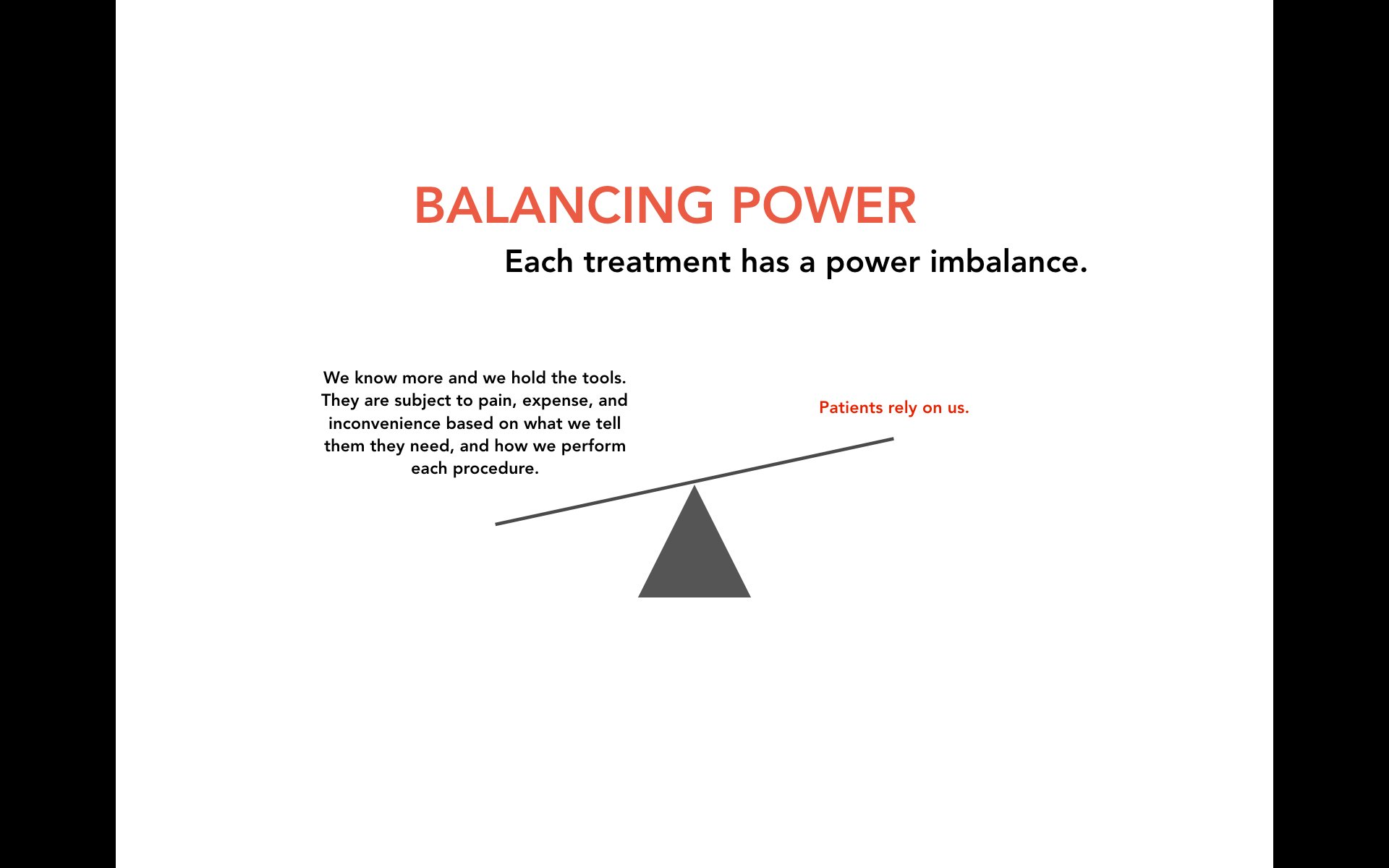
From our experience, we believe that they’re universal in one proportion or another. It comes down to the way power is balanced by default. They are more or less all specific aspects of being out of control:
Now, there’s nothing unusual about being out of control when you seek any kind of expert help. When you go to a mechanic, you either take their recommendation, use your own knowledge to create rationale for why you don’t need to, or you get a second opinion.
With medical experts like dentists and dental hygienists, the fact is, each patient, to some extent:
Must take our word that it’s important to do what we say they need to have done,
Must pay the price we name,
Must get it done while we’re open and on days we work, and, on top of all of this,
Has no ultimate control over the pain or discomfort they may experience.
This is a lot for them to be coping with without some support from you and the Team.
It’s too much.
Put simply, practices that understand this prosper and grow through loyalty and referrals, and practices that don’t are where those referred patients come from.
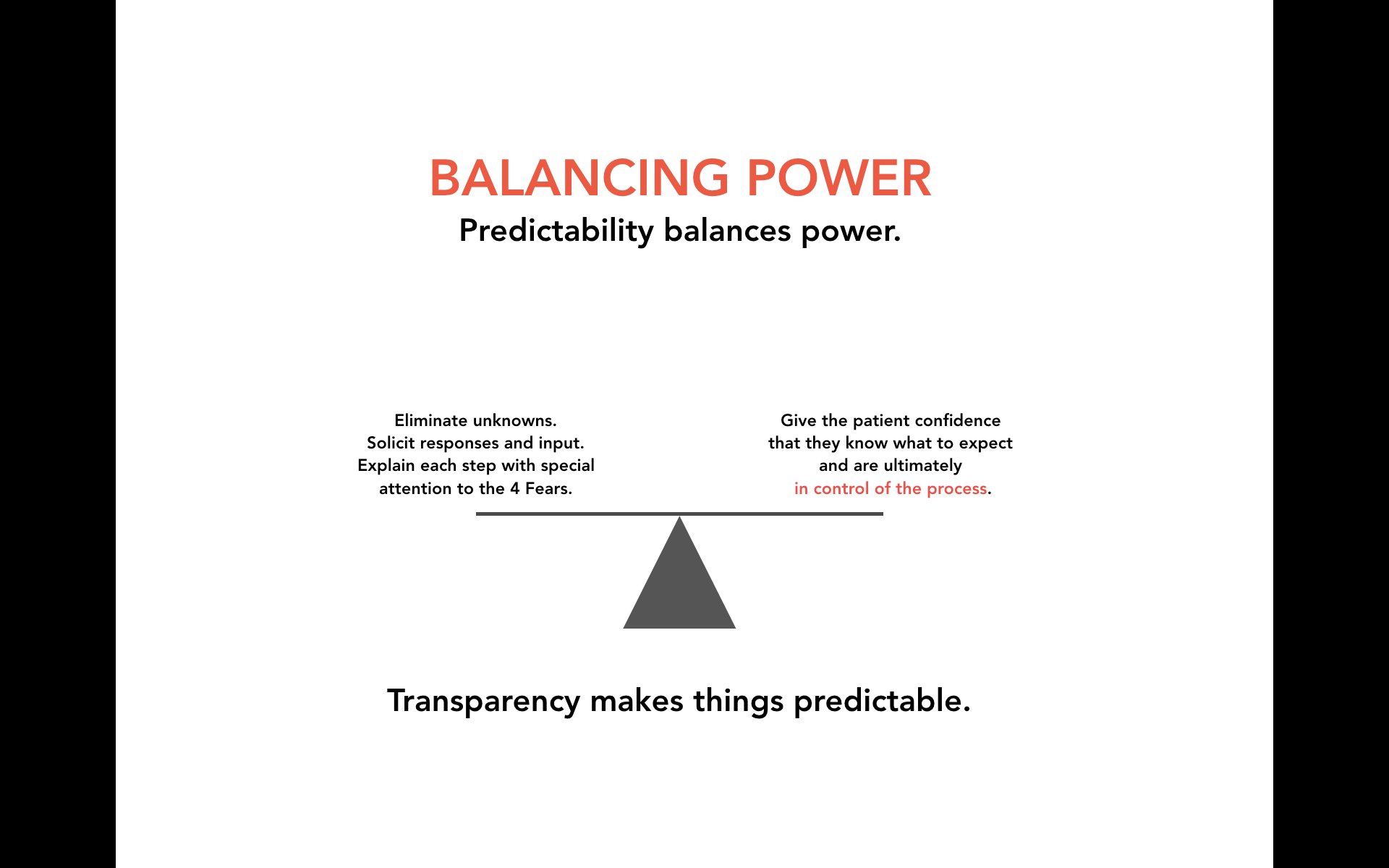
It’s the job of caring providers to make active, systematic effort to balance power in patient interactions, and doing so is essential to running a patient-centered practice.
How do we do that? By building trust.
Balancing Power By Building Trust
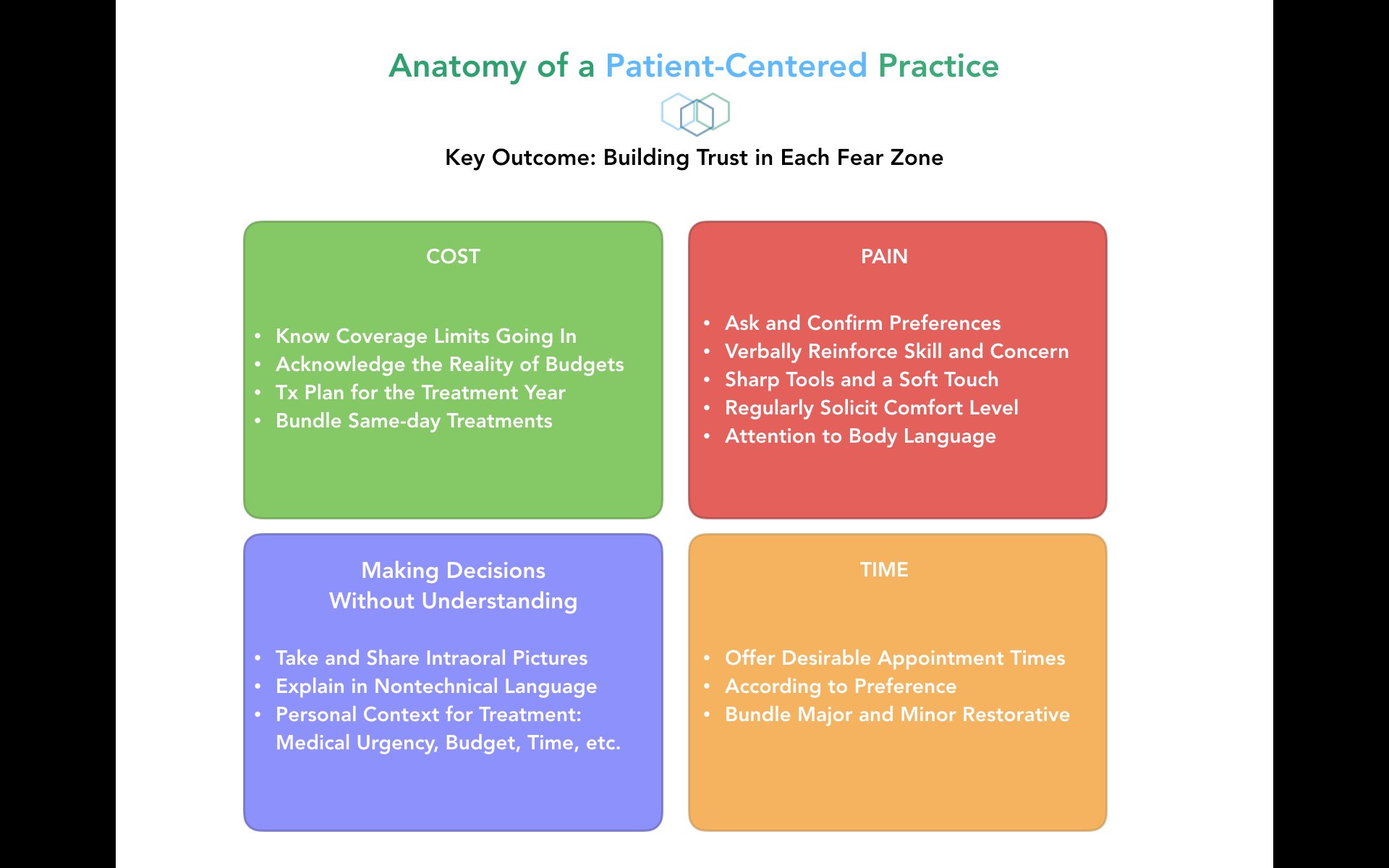
So if it’s our job as caring oral healthcare providers to manage this imbalance of power by building trust, how do we do that? The graphic above gives the overview. It’s something of a charter you write for your patients. These are the things they can trust you to deliver in light of their concerns, and these are the things you do to combat the 4Fears.
Cost
Know Coverage Limits Going in, so you know what is reasonable for them to afford.
Acknowledge the Reality of Budgets. It may feel like a tacky subject, but you may appear clueless or greedy if you aren’t aware that some months may be better than others for dental work, and some work may require a serious financial decision.
Treatment Plan for the Treatment Year: Once you understand the patient’s unique situation in terms of priorities, budget, and preference, do the legwork for them in mapping out a plan that helps them get their work done in a clinically acceptable timeframe and within their budget by looking at the full year’s coverage. More on that in the next item.
Bundle Same-day Treatments. It’s a win-win to offer patients a discount for multiple procedures on the same day. You can probably think of other discounts that will help patients stretch their budget and avoid putting important work off. Be creative. Patients will be sincerely impressed that you care more about taking care of them than getting paid.
Pain
Ask and Confirm Preferences. This shows that you want them engaged in the process, which lets them know that they have control. Think of it as showing them that they have access to the brake pedal. This is all 80–85% of patients need in order to feel no anxiety, and having a feedback loop with the patient open will help you stay on the good side of their perception of discomfort and pain as you treat.
Verbally Reinforce Skill and Concern. Patients don’t mind hearing that you or your coworkers are good at what you do, and studies show that it helps them notice that you are. Demonstrating that you care through empathic questions and assumptions—or wise caution in making them in the first place—are comforting shows of credibility.
Use Sharp Tools and a Soft Touch. It’s worth having a memorable phrase like this to use as a mantra.
Regularly Solicit Comfort Level. It’s important to know you’re interested and it’s important to give the patient regular intervals to provide feedback.
Attention to Facial Muscles will pay off in your ability to judge patients’ true level of comfort, even without their saying something. As these muscles are tensed automatically, they can reveal discomfort while it is below the patient’s level of conscious perception—or threshold of speaking up.
Making Decisions Without Understanding
Take and Share Intraoral Pictures every patient, every time. How often have you started a complaint “If THEY could see what I can see...” Well, now they can. Patients want to see what’s going on. If you want them to understand, show them.
Explain Everything in Nontechnical Language. Don’t use words your mother wouldn’t use. If your mother is a dental person, don’t use words my mother wouldn’t use.
Provide Personal Context for Treatment: Take the specifics of the need for treatment, coverage details, and the specifics of the patient’s capabilities and preferences into account and present treatment accordingly. Put options together. Discuss options as a way to help understand the issues they are trying to navigate. Don’t just print out the price and hand it to them. Creativity and consideration here are so valuable to helping patients make good care decisions that they are happy with.
Time
Offer Desirable Appointment Times. Have great pre- and post-work-hours appointments available.
According to Preference—and after showcasing those great options, ask patients precisely when they prefer to come in.
Get Patients In and Out On Time. Making them wait or leave late ruins the impression that you care about their time.
Bundle Major and Minor Restorative and explain the clinical and practical reasons for doing so. Multiple visits are a hassle for patients and can be a drain on your efficiency, so help to minimize them for everyone’s sake.
Good for Us, Good for Them
Patients may not have ever put their feelings into words, but they certainly appreciate it when you and your Team have taken the time and made the effort to understand the experience from their perspective and base your standard operating procedure (your Patient Experience Design, which we’ll blog about later) around mitigating these fears.
In fact, you could print out this graphic or make your own version to hang in exam rooms, or in a drawer to pull out as a visual aid for conversations. Each person has their own mix of these fears, and using the 4Fears—a list of universal, perfectly reasonable fears—as a framework for conversations can help patients feel comfortable discussing what concerns them the most.
Not only is it important to navigate these conversations successfully in the moment, for each patient, so you can give them what they specifically need, but it’s important to gather and analyze this information for all patients, to understand the needs of your patients as a group and how you can focus your Team efforts to deliver these needs more reliably.
4Fears and Patient Experience Design
The Patient Experience Design (which we’ll blog about soon) can seem like a daunting thing to put together. Where do you stop? Honestly, where do you begin?
But designing the systematic approach your Team agrees to take to deliver great patient experiences is easy when you use The 4Fears as a framework for understanding the requirements of a Patient Experience Design that will make patients feel cared for and safe—which are the crucial prerequisite building blocks of trust for earning patients’ respect for your judgement about treatment, their loyalty, and their desire to refer their friends and family to your care.
These are the 4Fears:
Cost
Pain
Making Decisions Without Personal Understanding, and
Time
Patients want you to handle these fears. You will earn their trust and loyalty if you do.