One: Deciding If, When, Who and How
Associates: Your Most Demanding Growth Step
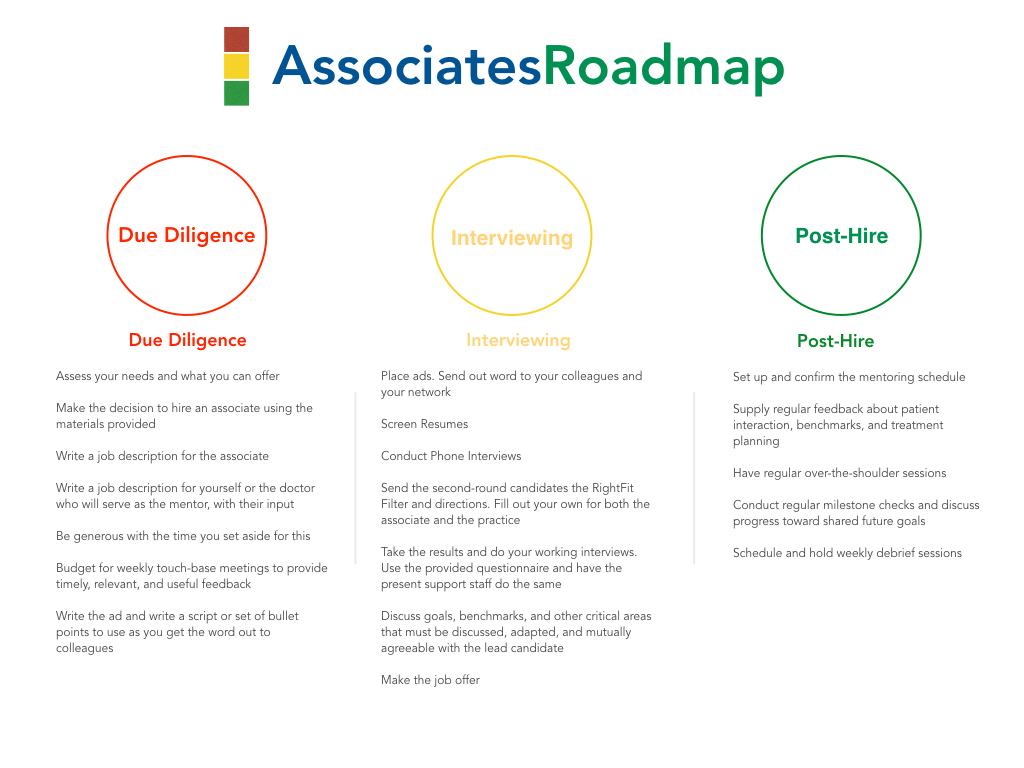
One
Deciding If, When, Who and How

What’s the Big Deal, Anyway?
Adding or taking away a dentist is the largest stressor and fear for a practice. Both the team and your patients will require extra care and attention to make it through the transition with their trust and optimism in place. On the other hand, adding a dentist is necessary for reaching the next level of success.
Usually associates are hired to expand capacity. That either means increasing available overall appointments, or allowing existing docs to reconfigure their time for efficiency, preference, or temporary or permanent sundowning.
The effort and commitment undertaken to increase or improve capacity is pointless if you lose patients or unmoor the practice culture in the process. For this reason, you will want to be methodical about thinking through your expectations, goals, and game plan. Here we will provide some considerations to help you cover your bases, as well as a framework to record the results of the analysis and make them actionable.
Deciding When:
For The Practice as a Business
Here is a chance to get a focused reality check and a more detailed assessment of what is involved in this process. You will run through a similar process again once you’re making the decision to hire a particular candidate.
In General
Here is a rule of thumb to use in a growth-centered practice:
If efficiencies are in place and patients still can’t get in for treatment in 2-3 days, it time for an associate.
In a fully functioning, growth-centered practice, patients require 60-70 hours a week of business hours to assure prompt access to convenient appointment times.
If your business model has always been to grow as much as possible and to keep expanding capacity, this is the rule for you.
Not everyone has made the shift into a growth focus, though. If you have any other reason for hiring an associate (see below), at the least you must establish whether there is sufficient patient flow to provide the associate with opportunities for production that cover their expected salary.
What You Want, What You Can Give, What You Can Get
First, ask yourself:
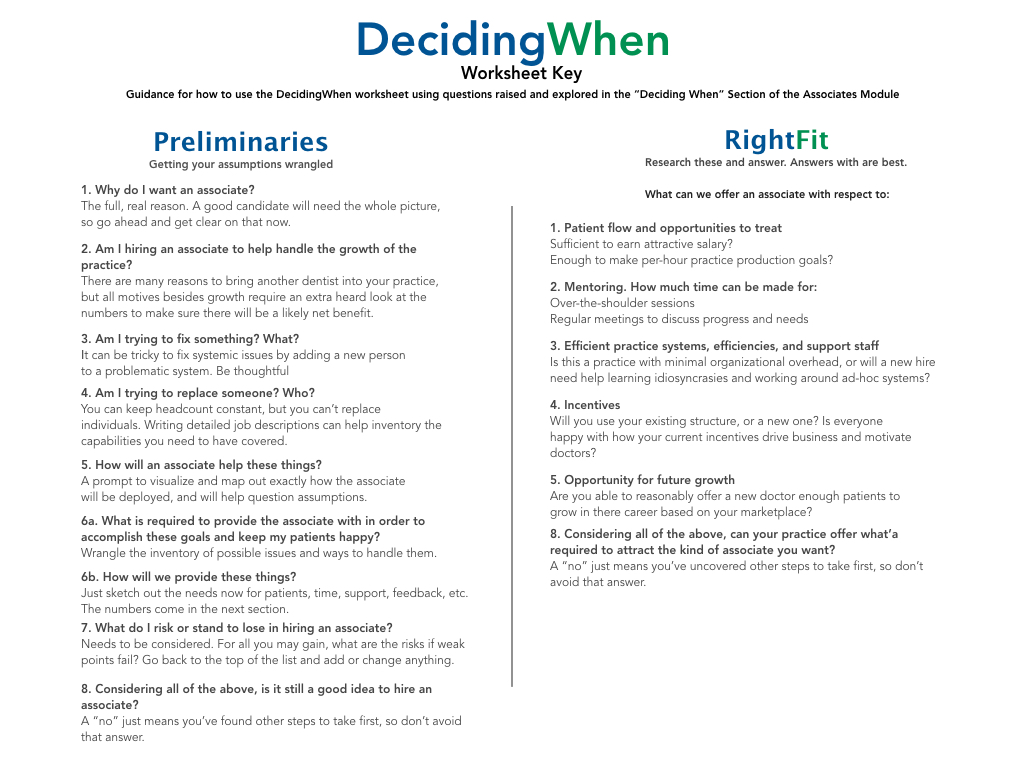
1. As an owner or manager of the business, as a doctor, and as a person, what do I want from this associate?
Be honest now, and brutally so.
Sure, ideally you hire an associate to grow a practice. But why are you doing this? Really.
Are you trying to prop up a failing or sundowning partner? Is that partner yourself? Are you hoping to bring new capability into the office? Someone younger? Someone to handle kids?
Are you hoping to work a new graduate like a dog in exchange for a vague promise you hope to never have to deliver on?
While some motives will yield better results than others (see #2 below), you need to be absolutely clear as to why you’re considering hiring a new dentist.
A word of warning before you get too far
You can’t expect a new grad to do a good job without mutually-desired supervision and mentorship. New grads have much to learn. In fact, this second education is much of what you have to offer your associate.
They leave school ready to perform procedures and treat disease, not to treat patients, and have only their default notion of what it means to treat patients as people and as customers.
Mentoring and structure are have-to-haves. Reconsider the whole thing if it isn’t possible to supply this.
It’s not just about doing the right thing, either. You won’t get what you want unless you have all the resources necessary to handle the mentorship aspect of having an associate. Don’t lose patients to wishful thinking.
Whatever the case, there is tremendous value in being clear about what you want from this arrangement before you have made it.
Now ask:
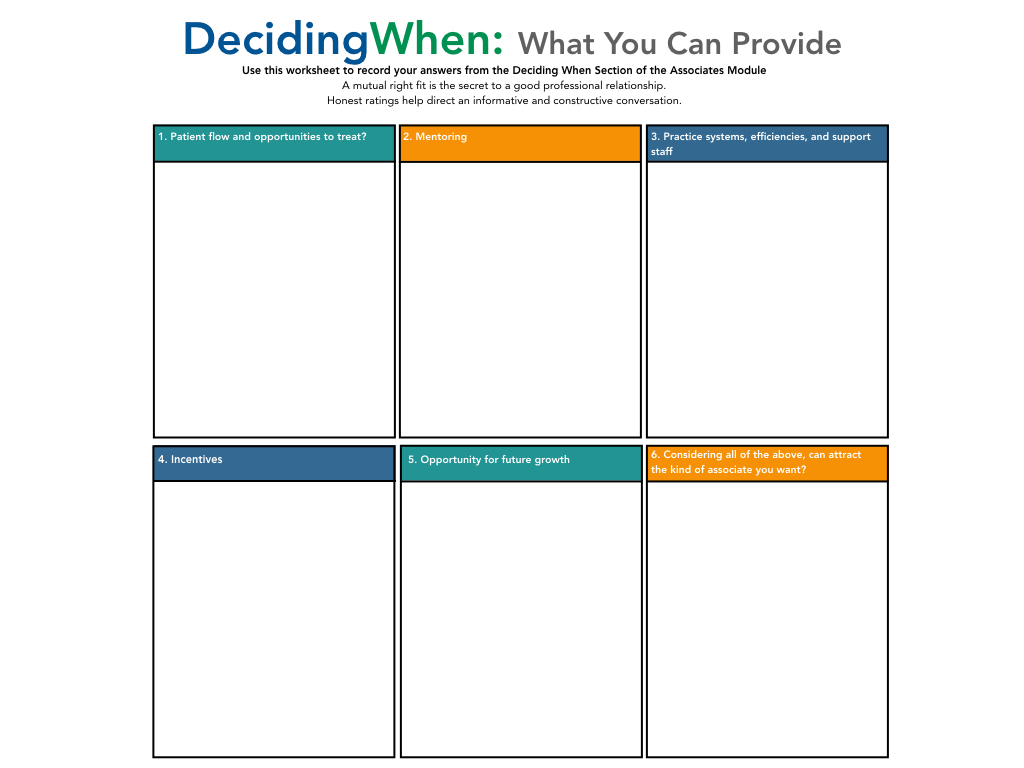
2. What can I offer them? What you can offer determines who you will find.
Do you want to whatever time it takes to teach a new grad all your tips and tricks, or do you need to fast-track someone more experienced into ownership? Can you offer them enough patients to immediately ensure an attractive level of production? What performance incentives can you offer?
One of the key concepts in hiring anyone, especially an associate, is Right Fit.
In short, this means that there must be transparent mutual agreement that the arrangement you come to works for everyone involved.
Therefore, what you offer must work for the person you offer it to.
This sounds simple, but, when you undertake any enterprise to accomplish something you need, it’s easy to overlook what prospective collaborators will need and rightfully require.
What you can offer is directly related to who you can attract and keep.
At this stage it pays to be thoughtful. Keeping in mind the resources you have now, future projections, and the goals you have for the business, what are you willing and able to confidently, prudently present to a future business partner? Is it a good offer? Would you take it?
You’re not doing this to draft the ad. You can and should leave the details out of your ad and in how you pass the word around to your colleagues.
No, clarity here is more about getting down to brass tacks about the real mechanic at the core of the decision: partnership.
You will likely uncover faulty assumptions and extra sub-steps required before taking action.
Even if your mind boggles now at the list that forms, having that list now is 100% positive.
Going in prepared makes everything more likely to succeed.
There is no guarantee with partners. Manage your risk wisely, and use this step as an opportunity to take inventory
Use this moment in time to get clear about what your practice is, what it can predictably be, and what your vision is for the future beyond that.
From there you will be able to almost mathematically work out what you and are willing and able to share and provide this prospective employee, mentee, and future business partner with in order to set them up for your mutual success.
Estimates about mentorship, equipment, space, staff, patient flow and more should all be considered. Be realistic and generous in budgeting for these so you can deliver when the moment arrives.
After going through these discovery steps, you will also have more detailed clarity about what you will need to require from the associate. From here you can start to work out some baseline goals for them, as well as understand specifically what you will have them do. Will they handle or specialize in certain types of patients and treatments? Certain shifts? All of this will help when you set up your feedback loop and communication scheme later on in the process.
Deciding When: More Perspectives to Consider
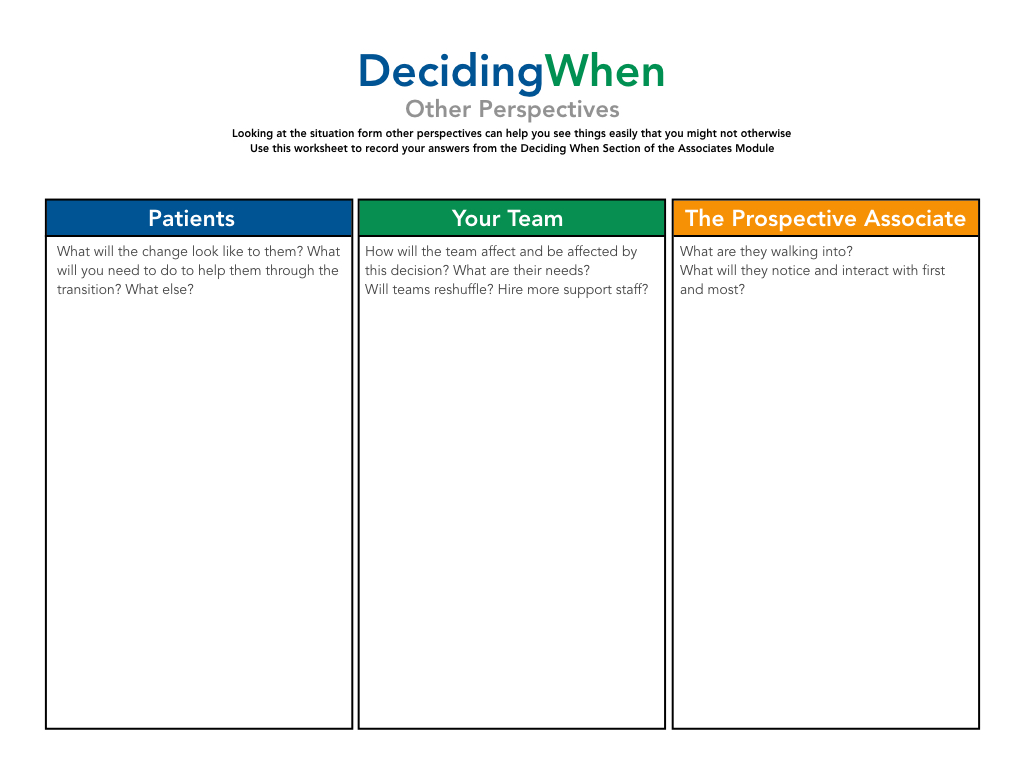
As you do this thinking, make another list that considers the decision from three other perspectives:
- Your patients. What will the change look like to them? What will you need to do to help them through the transition?
- Your Team. What team factors will be affected by this decision? How will they affect the process? If hiring an associate is part of a larger plan to expand hours, the team will already be primed for changes. Are there enough assistants? {What else?}
- The prospective associate: What are they walking into? How will you supply the proper context for them to hit the ground running, treat your patients, and work with you and your team?
Record these answers on the worksheet or in your notes. Review them as you progress through the process to keep these insights in mind. As you revisit them, see if you can reduce them into guidelines and bullet points to help focus your efforts.
Deciding When: Successful Outside Perspectives
If you have colleagues who have been successful in hiring associates, talk to them now. Their situations may be very different from yours, but it may benefit you to learn from the the pitfalls, oversights, and good ideas of others.
Once you’re clear on why you’re making this decision, and once you’re clear that it’s the right thing to do for your business, and for you as a person and a doctor, it's time to make it happen.