
Post-Hire
Associates: Your Most Demanding Growth Step
Mentoring
While mentoring is best put in place upon hiring, this section is just as applicable to overhauling or starting the mentoring of existing associates in your practice.
Mentoring: First Impressions
Be clear on your expectations on first impressions. You may need to have frank, no-penalty conversations about your patients’ expectations that they look, speak, smell, and act their best. Do you want them to present themselves to the same standards as you or the other doctors in the practice? Talk about it with them. Explain how first impressions make a difference, and give them clear direction. It can be feel like a sensitive matter, but talking around it and hoping for the best will not work. Use the Conflict Buster tool, or your own version in your notes, to help facilitate this conversation.
Mentoring: Over-the-shoulder Time
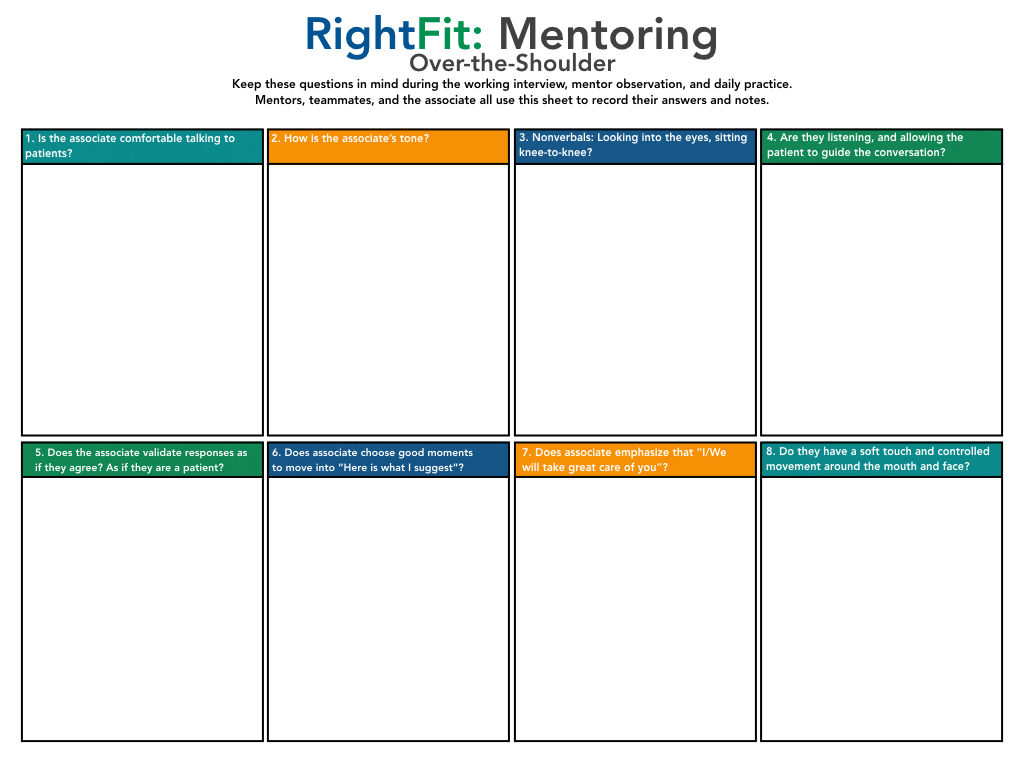
An associate is an associate because they aren’t ready to run their own practice. You cannot hire one, leave them to work unsupervised, and expect things to go well.
There is no autopilot for associates. This means you will have to teach. You will be glad you did.
Simply getting used to a new environment is stressful. A dentist has a lot of pressure on them besides this. You will get better performance from the associate, they will make patients happier, and they will acclimate more smoothly if they are getting regular support and feedback, know how they’re doing, and know who to ask for direction and guidance on everything from clinical pointers to learning the fine art of talking to patients. So watch them work. Book time, get the patient’s permission, and pay attention.
As you notice the associate struggle or make non-optimal decisions, try to imagine where their trouble or misunderstanding is coming from. When you debrief, offer your interpretation, then ask what they think they need help on. Really communicate and get to the heart of the issue. Share your honest assessment and ask probing questions to help them understand what they should be doing, and to help you understand where their blind spots or untrained areas are:
“I know this is what you were looking for. How can I help you?”
“When I was watching you, I was looking for (x). Here’s what I noticed. I’d like to show you something you should know about when it comes to those.”
“Here’s what I see you performing with respect to (x,y,z).”
“What causes you to hesitate when you (x)?”
Talk about benchmarks. Ask: “Are you seeing what I’m seeing? Are you comfortable diagnosing what I would diagnose?”
The mentoring process will be helped if you have some insight into the way the associate thinks an initiates action. It’s worth the money to have them do strengths-finding inventories like Kolbe and DISC for exactly this reason.
Watching You Work: Before the Treatment
Teaching your standards is how you ensure your patients get care that’s as good as you would give or better. Helping the associate accomplish a working understanding of your standards will require both repetition and hands-on teaching. The associate needs to watch you work.
The formula is:
Tell them, show them, then have them tell you what they saw.
Before each of these sessions, prime the associate on what treatment you’ll be doing, and what to look for. In addition, reinforce two more areas of awareness as they watch you or the mentoring doctor work:
First, give them the FCTD talk, explaining the 4Block roles as a mnemonic for the most important aspects of their job. This is included in the materials with this module.
Second, explain that they are “onstage” when they are working on a patient, and help them come to grips with how they will handle this all-important reality. Their presence and how they connect make all the difference. This philosophical, human-level stuff is as important to teach as the dental techniques.
Show and explain as clearly as possible, while sharing clear and persuasive rationale. You’re teaching, and you’re providing an example of what you expect from them, and what your patients expect. This is the only way to honor the trust the patient has placed in you. You have earned the trust, and now you must help the associate maintain it.
Watching You Work: With the Patient
You will need to be free to talk about everything in front of the patient. Get their permission. Then, introduce the associate to the patient. Talk them up and explain what you’re doing.
“Hi, Mary. This is Dr. Jones. They’re my new associate. They came from (x) and they’re very talented. I’m teaching them and they’re teaching me, and they’re going to watch me take care of you today so I can show them why I’m your favorite dentist.”
Have a debrief afterwards and ask your associate for their narration of what they saw, how their understanding shifted, and any questions they have. Then, go over the key takeaways again. These are also excellent opportunities to instruct the associate about how to talk to patients.
Mentoring: Setting Benchmarks and Goals
A fundamental lesson of a good dental apprenticeship is that good dentists are careful, clinically excellent, and respectfully cognizant of their patients’ comfort and time. The first rule of benchmarks is to make it clear to the associate that there are and will always be benchmarks for each procedure. It’s also an important lesson to learn that these are not arbitrary or money-focused whip-cracking on your part, nor ambitious or personally perfectionistic go-getting on theirs.
Instead, benchmarks derive directly from the length of time a patient can comfortably sit in a chair, and the number of visits a patient wants to make time for to clear the board and complete all their needed treatments.
Sharing and discussing this rationale helps the associate understand the big picture of production efficiencies in general, and how they relate to patient care outcomes and patient satisfaction, which drive the profitability of the practice through patient loyalty and referrals.
The Key to setting specific benchmarks is connecting the end goal to what is possible now. It may take them two hours to do a root canal today, but eventually it should only take 45 minutes. That’s what’s fair and comfortable for patients, and that’s what’s predictable and profitable for the practice, which in turn allows the practice to facilitate payment flexibility for patients and incentives for the team, and so on. In short, your patients and the practice can only handle this inefficiency on a stopgap basis.
Measurement, Goals and Progress
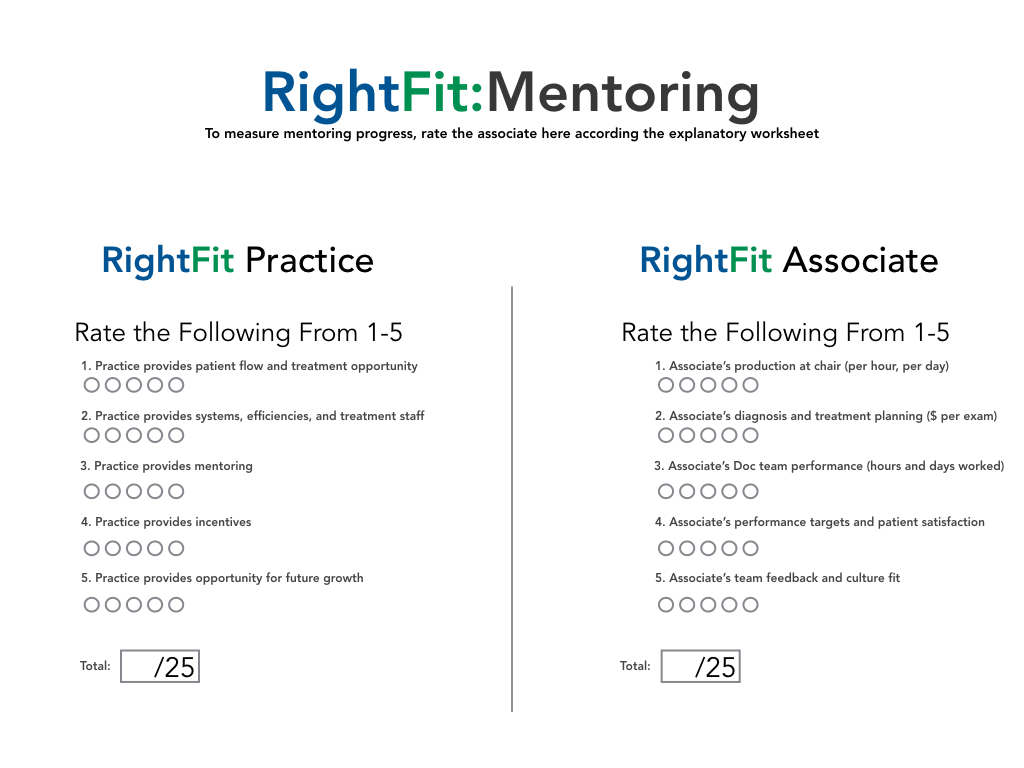
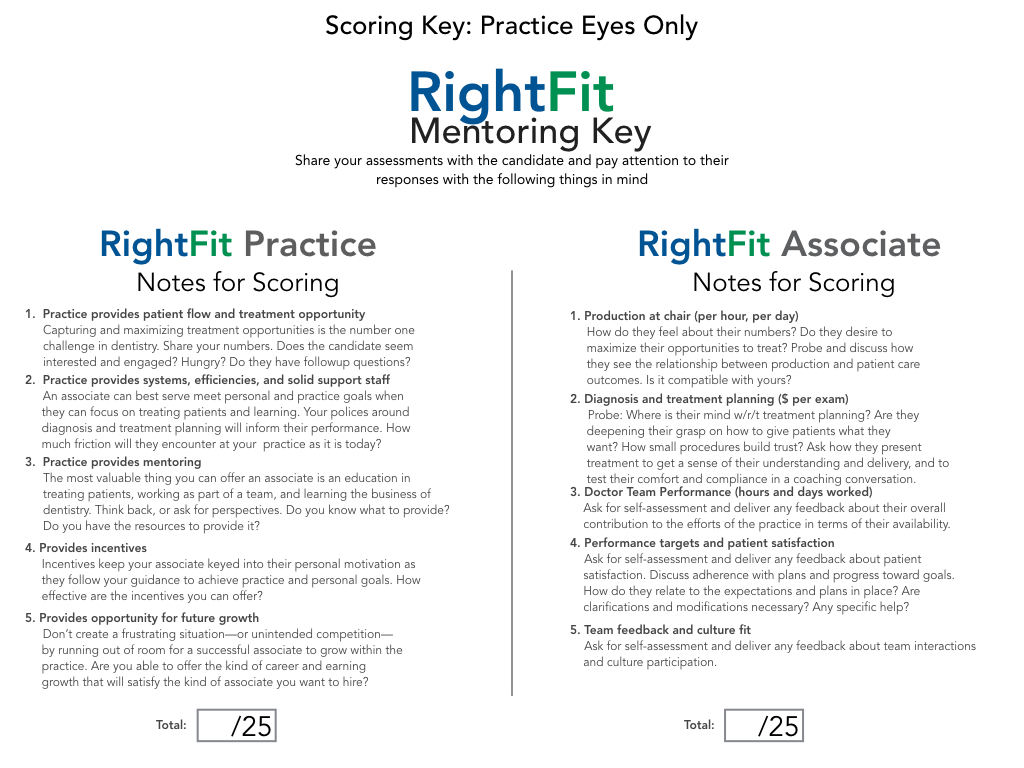
Getting an accurate assessment of what is possible is step one. How long does the associate take for each procedure now? Witness and discuss how the associate approaches and performs each procedure to help them maintain patient comfort and high quality while accomplishing greater time efficiency, with an eye toward the ultimate benchmark at all times. Applying this guidance in daily practice and reinforcing necessary learning in weekly debriefs leads to experience that translates into improvement.
$1000 Challenge
For dentists in their mature career, a worthy goal is producing $1000 per patient. It’s a useful northstar, even if it’s considerably more than you’re doing now. Meeting this goal requires everything to be in place for maximum production, including patient flow, appropriate staffing, hygiene recall and other practice systems, chairside efficiencies, patient comfort, and top-tier patient interactions and treatment planning.
We can only manage what is measurable. What is measurable is production. Trying to make this goal happen, finding the limitations, and taking steps to improve is a manageable, measurable approach for an established dentist with a growth mindset.
Along similar lines, a production goal for associates is the best way to bring everything to the surface in order to achieve the best possible outcomes.
Let’s look at a baseline goal for the end of an associate’s first year. A dentist who is a solid average performer will produce $500 an hour chairside. If this sounds high, now is a good time to go back to the beginning of this booklet and reassess if you have the current patient flow to handle hiring an associate.
At $500 an hour per dentist, you are on track for a 40% net across the practice. Closing the gap between first-day associate performance and this overall performance benchmark will supply the structure and end goal of the first year’s mentoring and coaching. A clear and streamlined way to help your associate make this milestone is to teach them the value of chairside efficiencies: preparing for their day, learning to read their schedule with an eye toward pulling treatment in from hygiene checks, diagnosing quadrant dentistry, and bundling small treatments into larger ones. There are always small treatments. As a rule of thumb, teach them that every time a patient gets anesthetic, they need to be doing more than one procedure. This maximizes patient in-chair time.
Further, by booking them for a smaller treatment in the same appointment time as a root canal, crown, or similar, the associate learns to use their time more efficiently than any verbal directive or advice can inspire. If your practice has the systems in place to accommodate this, this approach can be started while the associate is still doing treatments they don’t personally diagnose.
As you teach the associate diagnosis and treatment planning, the learned virtue and track record of patient satisfaction that comes from bundling multiple procedures will inform their approach. They will have supreme confidence in presenting all diagnosed treatment.
This mentorship approach to diagnosis and treatment planning gets new doctors over the common problem area of avoiding “No” by under-presenting and agreeing to “just keep an eye” on treatment that is better off being done as it is diagnosed. This avoidance can last a whole career if it isn’t dealt with. Helping an associate avoid this pitfall will provide lifetime value to the associate and the patients they treat.
The systems and best practices your practice has in place for multiple same-day treatment discounts and payment flexibility go a long way to making this approach work. To respect and remain applicable to individual approaches, this is presented as an overview. Any of this can be adapted to your current systems. For more information on our treatment planning concepts systems, and training methods, please see other GP modules on that topic.