
Two: Making It Happen
Associates: Your Most Demanding Growth Step
Two: Making It Happen
Hiring and Interviewing Now that you’ve armed yourself with more accurate assumptions to inform your needs, goals, and offer, it’s time to translate these facts into the communications you will have with your associate candidates, your team, and your patients. Use the Conflict Buster tool to parse and script the transparent conversations you will have inside the practice as you inform the necessary parties about the process.
Now let’s put together the emails and ads you will send out to cast a sufficiently wide net to increase your odds of finding your Right Fit Associate.
Getting the Word Out
Take a look at the ads practices in your area are placing on Craigslist, Kijiji, and other job boards. This will give you an idea of how others are communicating and will help you make a complete inventory of the kind of information you will want to offer your prospective candidates.
The basic list of information to include in your ad is:
• Location
• Type (small, large, private, clinic, chain, busy, growing, startup, etc.)
• Type of arrangement offered (transition to ownership, full-time or part-time, specific shifts etc.)
• A nod to the company culture: (Patient-focused, close-knit, respectful, family-like, professional, growth-minded), lifestyle benefits
• Compensation, benefits, guarantees, and incentives offered. In competitive markets and/or where it is typical, you may want to advertise actual dollar figures, but this is at your discretion. Most associates will assume the going rate if nothing is given. If your ad response is slow, this is an area to update.
• Required certifications, experience, specialties, etc. Will new grads be considered? Say so.
• What to send: Resume, cover letter, references, etc.
• Response method: Email only, calls ok, respond to this posting, etc.
• Optionally include equipment and systems list, and other background information.
Make your choices based on what you can offer—remember, this will dictate who responds. Include everything you feel is appropriate in a public forum where patients and competitors might come across it. Save the details for the interviews.
If you are in a growth phase and doing well, feel free to name your practice and use your logos and branding, but be sure to treat this as a marketing communication and follow the same rules and standards you would for any other. If you have any reservations or concerns for your privacy, it is common not to share the practice name until the interviewing stage and you should feel free to leave this off the ads.
Use a format you like and be sure to use language that communicates your values and mindset toward the partnership. The difference between being in a good candidate’s shortlist or not will be whether they received the impression that you will be a solid investment for the next few years, so be sure to balance out your needs and requirements with what they will get out of the bargain.
Don’t plead your case in the ad, though. Just make sure you’re not leaving out something that speaks to the learning, support, respect, and growth potential your practice has to offer. These words and phrases are all worth including, and fit nicely in a single sentence. You can share links to the posting itself with your colleagues and your social networks as you find appropriate, or use the ad as a basis for emails and posts.
Handling Candidate Responses
As the responses come in, you will get emails and calls back. Set up calls with candidates whose resumes and cover letters you like. If you are turned off by their communication style on the phone, move on. The details and expectations you share during these calls allow for candidates to step up or step out of the running without any wasted time, and will set the stage for the real conversations and negotiations later in the process.
If you’re getting a caliber of candidate you aren’t happy with, look at your ad and make sure it’s making your offer look as good as it is. Failing that, look at the offer and see if you need to make changes. The next round candidates get an interview.
If it’s difficult to schedule an in-person interview, you can use video conferencing like FaceTime, Hangouts, WhatsApp, etc., according to your comfort level and candidate interest to keep the process moving. This can be a good way for two employed dentists to schedule a conversation that reveals more than the telephone can. It will also set a comfort level and open your mentoring process up to use these convenient remote methods of high-touch interaction.
Getting and Checking References
It is to be expected that you will ask for personal and professional references. Use the questions in any of the included material to help you cover your bases in following up on candidate references.
Interviewing
There will be a lot of questions from both sides, so prepare for a conversational approach. This will give you a sense of the candidate’s Face-to-face, and also set the stage for your working relationship. Use the provided Associates Interview Questions list, or let them inspire your own questions. Use the Right-Fit Filter here to organize your meeting. This will help you cover and quantify key areas of competence as you go through this process.
It’s a good idea to have the candidate fill out a RightFit filter for you, too. Beyond getting an outside perspective on your practice, it will say something about the candidate’s willingness to participate in a growth mindset. This is a factor that will otherwise only be revealed too late in the game to easily fix.
RightFit Self-Assessment
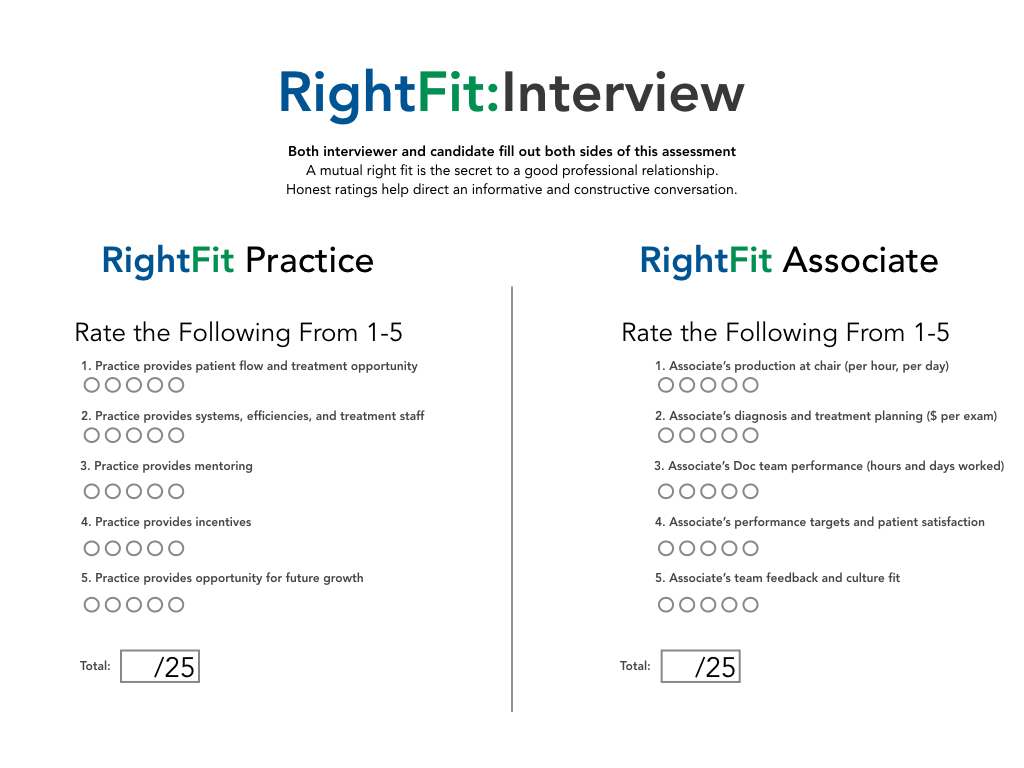
Both of you should fill out the RightFit Filter for both people. Honestly assesses the practice as objectively as you can. Self-assessment and constructive, accurate conversation is a miracle you can make happen. Interviewees will be polite by default. A frank assessment of what you can offer, followed by a request for a similarly frank self-assessment on their part, opens up areas of conversation that would otherwise be closed.
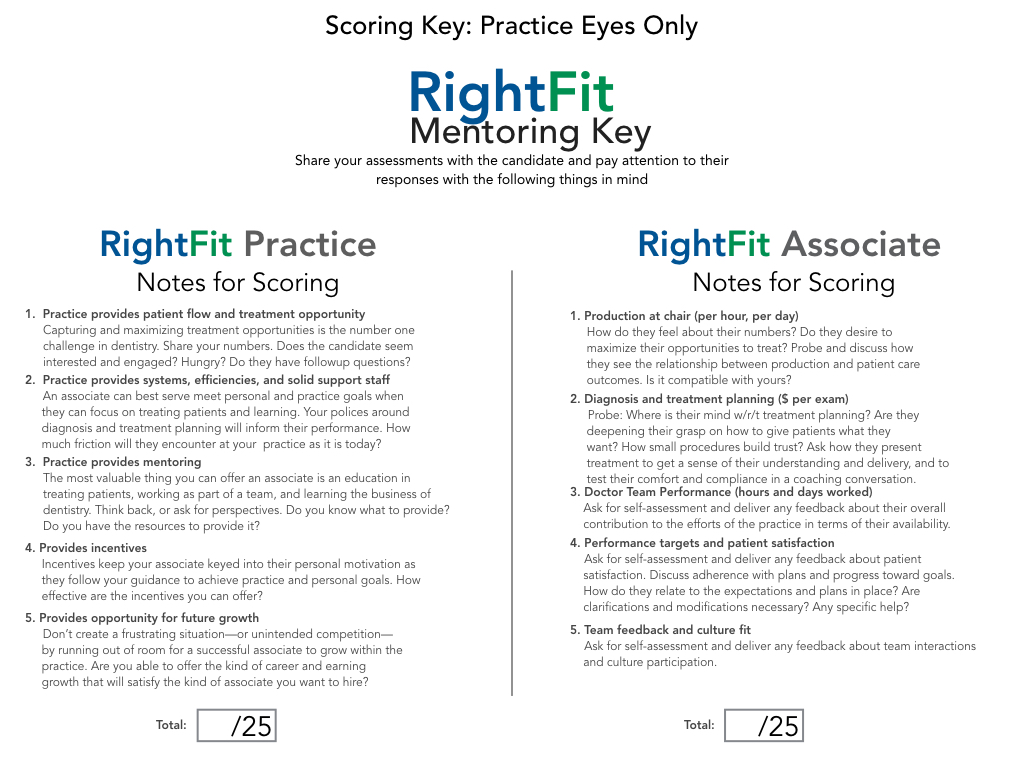
A Sample Case For Transparency
Don’t fear giving yourself a 3. Your honest assessment of the practice on a 5-point scale, backed up an explanation, is likely to reflect your high standards and goals for the practice above all else. For example, say you’re a profitable office, but you rate your patient flow at a 3. You explain that your current numbers aren’t a stopping point for you. You won’t be at a 5 until you’re doing 30% more. You discuss the numbers. Now you’re letting the candidate in on the future plans, and this will be a positive and constructive conversation topic for both of you.
You and the associate’s mutual self-assessments are an opportunity to have open, honest conversation that reveals your goals and personality, and establishes a foundation of shared reality and mutual trust. Transparency now, at this early juncture, is a beautiful thing. It’s best to get everything on the table that would otherwise remain hidden until after contracts are signed, time has been spent, and bad things have happened.
Speak Now, or Forever Wish You Had
As you have the interview conversation, listen and watch. If the situation seems odd, probe further. For example, if a candidate seems overqualified or later in their career than your offer should have attracted, why do they want to be an associate? If they seem unduly concerned with which procedures they will be asked to do, find out if they are have simple lack of experience or an anxious block that will boil down to never, ever being able to handle an extraction.
If something seems out of place or too good to be true, follow up. These are fair questions to ask. And of course you will reciprocate with transparency when it’s their turn to ask questions.
Diagnosis and Treatment Planning
Now is also the latest in the process you should wait to discuss in detail your philosophy, best practices, and expectations for patient care, diagnosis treatment planning. This can be a highly personal subject for some dentists, and you will need to establish consensus and agreement about this utterly crucial aspect of their daily practice before you progress in the hiring process.
If you have concerns about this conversation or any others, use a Conflict Buster worksheet, or your own version in your notes, to make sure that you have the full inventory of your needs, expectations and rationale. This will ensure you are able to have this conversation completely. This is especially important if you are feeling like you are leaning hard towards one candidate.
Their ability to work with your methods for treatment planning is in many ways the practical measure of how they will affect your patients’ experience with the once you give the associate your patients. Once all things have been answered and discussed, it’s time to set up a working interview.
The Working Interview
You or the docs in the office will want to arrange an over-the-shoulder session to watch the candidate work, watching for personal and clinical habits as well as culture fit. Use the Working Interview Questionnaire as a starting point to make sure that you are looking for everything.
Schedule the working interview and make sure your best people can work with the candidate that day. Putting multiple good pairs of eyes on the candidate will benefit you greatly. You can uncover possible pitfalls or even untapped potential previously unguessed at that can be discussed and dealt with before they have been hired. Have your best people, whose ability to assess the candidate is trusted and likely to be accurate, work with the candidate. There is no other way to predict a good Team fit than to have your best judges of character and competence in all roles work with the candidate and take good notes.
Give them a format to report what they see and what they think and feel about the candidate. Use the worksheet supplied or your own variation of the questions below:
Things to look for:
• Are they comfortable talking to the patient?
• How is their tone?
• Are they looking into the eyes, sitting knee-to-knee?
• Are they listening and allowing the patient to guide the conversation?
• Are they personalizing the responses as if they agree? As if they were a patient as well?
• Are they looking to cut the conversation at the appropriate time to move into “here is what I suggest?”
• Are they emphasizing that “I/we will take great care of you”?
• Do they have a soft touch with the hands, with controlled movement around the mouth and face?
Moving Forward
If the working interview gives you reason to change your mind, inform them that you’re not interested in moving forward. If it goes well, congratulate them and discuss what you saw that you liked and didn’t. Move into discussing the details of the associate position. Talk with them in detail about the goals and milestones they will be asked to adhere to. The milestones and goals should now be very clear and concrete for both of you. If they aren’t, read “Mentoring: Setting Benchmarks and Goals” below to get started on making concrete benchmarks and daily and hourly production goals.
You are moving into the negotiation phase as you come to a mutual agreement on these goals and the other specifics of the agreement.
Timelines and Communications
Make a commitment that both of you can handle. Maybe 6 months on a trial basis, with a focus on mentorship, after which you can look at signing another agreement for the next term of 1-2 years. Whatever works. Make the mutual commitment to mentoring now. Get the timelines together. Agree on milestones and daily/hourly goals. Standardize weekly meetings and regular over-the-shoulder sessions. Make your plan together.